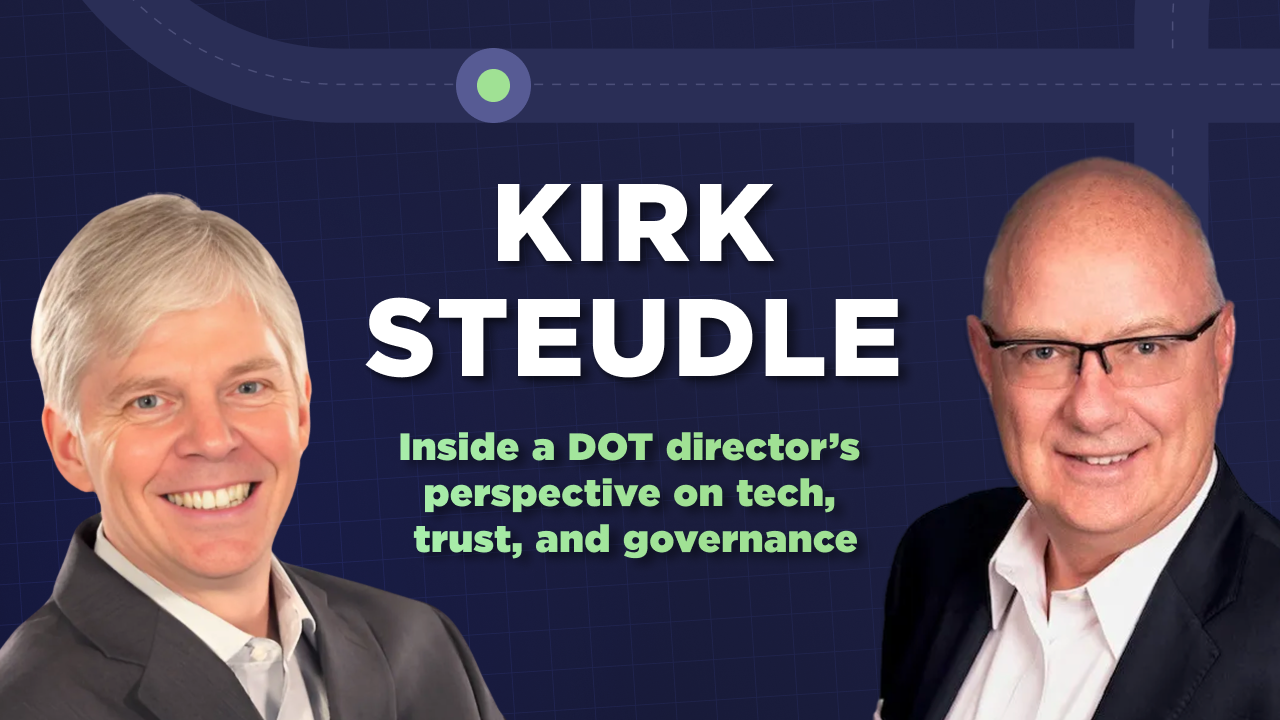
E3 | If AI Is So Powerful, Why Is Adoption Still So Hard?
Inside a DOT director’s perspective on tech, trust, and governance
Timestamps:
0:00 — Why AI Procurement Is Already Outdated
3:40 — What’s Different About AI Right Now
6:53 — The Risks & Rewards of AI Meeting Tools
10:52 — How to Evaluate AI Vendors (Cut Through the Hype)
13:42 — Rethinking Procurement for AI
23:41 — Career Advice for Future Leaders
Jim: Welcome to At the Intersection. I’m your host, Jim Anderson, and today I’m joined by Kirk Steudle, former Director of the Michigan Department of Transportation. Kirk also served as a senior executive at AECOM, among many other accomplishments throughout his career, and he has a technology background that serves him well as we talk about how AI is changing transportation. I should also mention, in the interest of transparency, that Kirk is an advisor to Beacon, and we’re delighted to have him helping us out. Welcome to the show, Kirk.
Kirk: Great. Can't wait.
Jim: All right, let’s begin with a lightning round. I’m going to ask you some quick questions and get quick answers to keep things moving. First question: what’s the favorite place you’ve been to in the past year? Where have your travels taken you?
Kirk: My travels have taken me quite a few places, but my favorite place is northern Michigan in the middle of summer.
Jim: Northern Michigan in the middle of summer. Great. At what age did you know transportation was going to be your path?
Kirk: That’s an interesting question. There’s a picture of me playing at our family cottage in Traverse City, in the parking lot, which was basically all sand. I was probably five or six years old and had a little egg beater from my mom. I was mixing up the soil and building little roads where the cars were parked. Looking back, I’d say that if my parents didn’t know it then, they probably should have.
Jim: Okay, age five. I’ll take it. Title of a good book you’ve read in the past year?
Kirk: There’s a John Grisham book — The Boys from Biloxi. I almost forgot the title. It’s a great mystery about an island off Georgia.
Jim: I’ve read that book, and it is a good one. I couldn’t remember the title either, but it does have “Boys” in it. Okay, what’s your favorite hobby outside of work?
Kirk: My wife and I do ballroom dancing, so we dance a lot. Recently, though, I moved into a new house, so I’ve been doing home remodeling. I can’t wait to get back to just dancing.
Jim: I think I know which one’s more fun. Excellent. Last lightning round question: finish this sentence — AI is blank.
Kirk: AI is coming around, and it’s more than just a talking point now.
Jim: More than just a talking point. Great. Let’s dive in. What’s different about AI today? You’ve seen lots of technology cycles come and go. What should people be thinking about now, and why is this different?
Kirk: What’s really interesting is that people have talked about what AI could do for about ten years. It was always, “It would be great when we can automate all these functions.” For a long time, AI was just a talking point. People used the term when they didn’t know what else to say in an interesting conversation. Five or six years ago, if you didn’t know what to say, you’d say “Bitcoin” or “blockchain,” and people would think you were smart.
What’s different now is that AI has moved into society. There isn’t a person in this country who hasn’t interacted with some kind of bot or agent. All those chat windows that pop up on retail websites are bots. Some people get frustrated with them, but they’ve moved into the mainstream. People are accepting them and expecting them. The technology has advanced to the point where it can now start doing some of the things we dreamed about a long time ago — having an agent in the background doing work that needs to get done but is boring. That’s what’s really changing the dynamics now.
Jim: So AI is coming fast. If you were still a DOT director, what would give you pause? What would you say no to, or slow-roll?
Kirk: That’s always the big question. Do you want to be on the cutting edge, the bleeding edge, or be a fast follower? In the public sector, you have to balance that with legislative and administrative support. Going to the bleeding edge without broad support can be risky.
The key question is whether there’s independent utility. Is this just a science project, or will it actually benefit the agency by improving efficiency or customer service? At the same time, you still need to look toward the future and invest in research, even though not everything will pan out. In a public agency, failures are remembered, even when the intentions were good. There are always Monday-morning quarterbacks.
Jim: Let’s talk about a specific example: meeting recordings. We record lots of meetings. Nobody wants to rewatch project meetings, but AI doesn’t mind reading transcripts. That creates a massive knowledge repository, but it also raises concerns about litigation, FOIA, and depositions. How would you weigh those pros and cons?
Kirk: As a public agency, there are times when you want very detailed notes — who said what, who’s doing what, and when. That’s what AI agents can capture. There are also times when notes are intentionally vague, summarizing an hour-long discussion into a few paragraphs. I think bots will need to evolve to generate summaries at different levels of detail.
There are use cases for both. Project meetings need detail. Policy discussions need summaries.
Jim: That reminds me of the quote often attributed to Jefferson or Franklin: “I’m sorry this letter is so long; I didn’t have time to make it shorter.” There’s real value in distillation.
Kirk: Exactly. I’ve seen both extremes with human note-takers as well. The key is matching the level of detail to the purpose.
Jim: And people — or machines — can get it wrong.
Kirk: Right. If I’m a public agency using AI note-taking, I’d want someone to review and confirm the output. AI can misinterpret statements, just like people can. Subtle differences matter.
Jim: Let’s shift to vendors. Every company is now an AI company. How should DOTs evaluate vendors and separate signal from noise?
Kirk: Start with skepticism. Ask them to show you where it actually works. Twenty years ago, someone pitched maglev down the interstate with fancy pictures. I said, “Build a prototype and show me it works.” The same applies now. Show me real deployments. Let me talk to customers. That separates real solutions from science projects.
Jim: How do you avoid analysis paralysis when everything is changing so fast?
Kirk: Procurement is a challenge. By the time you go through a six- or twelve-month process, the technology has changed. I’ve advocated for outcome-based procurement — define the outcome, not the method. Start with a few vendors, give them seed funding, evaluate progress, and require continuous upgrades. It’s like software as a service. At some point, you move forward, reevaluate in six months, and be willing to pull the plug if it’s not working.
Jim: That sounds similar to progressive design-build.
Kirk: It is. You’re cutting months out of the process by going directly to vendors and testing value early.
Jim: I want to talk about corridor coalitions. Everyone agrees collaboration is necessary, but it’s hard. Why?
Kirk: It goes back to our founding. States are fiercely independent. There’s a strong “not invented here” culture. Add frequent leadership turnover — DOT CEOs average about 28 months — and it’s tough. Trust is built at the career level, not the political level. Coalitions that succeed focus on building trust over time.
Jim: That makes a lot of sense. Let’s close with advice. You’ve worked in both public and private sectors. What guidance would you give leaders navigating both?
Kirk: Bureaucracy and politics exist in both. Leadership is about creating vision and moving people forward. The process is the same in public or private organizations.
Jim: Final question: what advice would you give someone early or mid-career?
Kirk: First, embrace your current role and do it well. At the same time, stay curious about what’s next. Be visible — don’t assume good work will always be noticed. Celebrate progress. And remember, no one cares more about your career than you do. This isn’t a race. Enjoy the journey and don’t forget to live your life.
Jim: That’s great perspective. Thank you so much, Kirk, for joining us today.
Kirk: It’s been a pleasure.
Jim: This is At the Intersection. I’m your host, Jim Anderson, and today we spoke with Kirk Steudle, former Director of the Michigan Department of Transportation. Stay tuned for more episodes with leaders shaping the adoption of AI in transportation. Thanks so much.
Emphasize your product's unique features or benefits to differentiate it from competitors
In nec dictum adipiscing pharetra enim etiam scelerisque dolor purus ipsum egestas cursus vulputate arcu egestas ut eu sed mollis consectetur mattis pharetra curabitur et maecenas in mattis fames consectetur ipsum quis risus mauris aliquam ornare nisl purus at ipsum nulla accumsan consectetur vestibulum suspendisse aliquam condimentum scelerisque lacinia pellentesque vestibulum condimentum turpis ligula pharetra dictum sapien facilisis sapien at sagittis et cursus congue.
- Pharetra curabitur et maecenas in mattis fames consectetur ipsum quis risus.
- Justo urna nisi auctor consequat consectetur dolor lectus blandit.
- Eget egestas volutpat lacinia vestibulum vitae mattis hendrerit.
- Ornare elit odio tellus orci bibendum dictum id sem congue enim amet diam.
Incorporate statistics or specific numbers to highlight the effectiveness or popularity of your offering
Convallis pellentesque ullamcorper sapien sed tristique fermentum proin amet quam tincidunt feugiat vitae neque quisque odio ut pellentesque ac mauris eget lectus. Pretium arcu turpis lacus sapien sit at eu sapien duis magna nunc nibh nam non ut nibh ultrices ultrices elementum egestas enim nisl sed cursus pellentesque sit dignissim enim euismod sit et convallis sed pelis viverra quam at nisl sit pharetra enim nisl nec vestibulum posuere in volutpat sed blandit neque risus.

Use time-sensitive language to encourage immediate action, such as "Limited Time Offer
Feugiat vitae neque quisque odio ut pellentesque ac mauris eget lectus. Pretium arcu turpis lacus sapien sit at eu sapien duis magna nunc nibh nam non ut nibh ultrices ultrices elementum egestas enim nisl sed cursus pellentesque sit dignissim enim euismod sit et convallis sed pelis viverra quam at nisl sit pharetra enim nisl nec vestibulum posuere in volutpat sed blandit neque risus.
- Pharetra curabitur et maecenas in mattis fames consectetur ipsum quis risus.
- Justo urna nisi auctor consequat consectetur dolor lectus blandit.
- Eget egestas volutpat lacinia vestibulum vitae mattis hendrerit.
- Ornare elit odio tellus orci bibendum dictum id sem congue enim amet diam.
Address customer pain points directly by showing how your product solves their problems
Feugiat vitae neque quisque odio ut pellentesque ac mauris eget lectus. Pretium arcu turpis lacus sapien sit at eu sapien duis magna nunc nibh nam non ut nibh ultrices ultrices elementum egestas enim nisl sed cursus pellentesque sit dignissim enim euismod sit et convallis sed pelis viverra quam at nisl sit pharetra enim nisl nec vestibulum posuere in volutpat sed blandit neque risus.
Vel etiam vel amet aenean eget in habitasse nunc duis tellus sem turpis risus aliquam ac volutpat tellus eu faucibus ullamcorper.
Tailor titles to your ideal customer segment using phrases like "Designed for Busy Professionals
Sed pretium id nibh id sit felis vitae volutpat volutpat adipiscing at sodales neque lectus mi phasellus commodo at elit suspendisse ornare faucibus lectus purus viverra in nec aliquet commodo et sed sed nisi tempor mi pellentesque arcu viverra pretium duis enim vulputate dignissim etiam ultrices vitae neque urna proin nibh diam turpis augue lacus.