Reading Between the Lanes (AASHTO 2026 Keynote)
A practical framework for understanding AI’s risks, opportunities, and real-world application at scale.

Timestamps:
Transcript:
Alright, good afternoon. I do indeed have a lot of slides, and we’re going to dive into AI today. I know you care about this. There were actually 215 slides—I think I pruned a few out—but I’ve got a countdown clock here. The AASHTO folks have made it clear: I’ve got my time, and I’m going to finish within it. So, as in any good presentation, you have to begin with some pictures.
So here we have the city of the future, that time Elvis met Napoleon, the world’s most annoying chatbot, a calculator, a pair of dice, a sand timer, an owl, and an umbrella. I’m just going to cover that. I mean, it’s your typical PowerPoint presentation at lunch. I’m sure you’ve seen things like that before.
But to begin, let me start with a 25-year rewind. What is it they used to say? “Be kind, rewind.” So let’s rewind 25 years from today—2026 back to 2001—and think about the internet. I want to compare and contrast those briefly.
I lived through the internet professionally, and most of you did as well. What did we have in 2001? About 140 million Americans were online. It was a popular time, and people knew the internet was coming. But only 15% were on broadband or high-speed connections. We were all dealing with those gurgling, noisy modems. It was slow, frustrating, and terrible.
AOL was the world’s largest internet service provider. Yahoo was a portal we all went to—it wasn’t really a search engine. That distinction mattered, because it didn’t become Google, which was a tiny company in 2001. It was growing, but not yet what we think of today. And now Google is so large it can’t even fit on a single slide.
We’ve seen a lot happen, and nobody could have predicted it back in 2001. We knew it was big, we knew it was coming, but we didn’t know what would happen. We went from dial-up to broadband, to search, to social media, to video, to mobile, to cloud, to streaming. Trying to imagine cloud computing or streaming in a dial-up world didn’t even make sense.
So I want to invite you to reflect on how far we’ve come. It’s easy to forget. There was a business reporter who tweeted in 2000 that Palm—the Palm Pilot company—was worth more than Apple, Nvidia, and Amazon combined. That’s incredible. I don’t give stock advice, but imagine knowing that at the time.
Now think about where AI might take us. The projected investment is $2.5 trillion in 2026 alone. That’s staggering. How will that compound over 25 years? None of us—myself included—knows exactly where this is going. That’s what makes it exciting and a little scary.
From where we stand, I think we can draw three conclusions: AI is bad, AI is good, and AI is misunderstood.
It’s important to bring skepticism. AI is not all magic and wonderful outcomes. There are substantial problems and harms. Most obviously, we can no longer fully trust what we see. That image of Napoleon and Elvis meeting? Completely fabricated. I could invent an entire backstory, and it would sound believable.
At the same time, Elvis really did meet Richard Nixon, and it’s a wild but true story. So how do we tell the difference?
Fake images aren’t new. Photoshop has been around since 1987, and even before that, in 1911, President Taft complained about manipulated photos. The difference today is speed, scale, and accessibility. It’s faster, cheaper, and requires no skill—just intent.
There are other concerns too. The CEO of Anthropic recently said we could see half of entry-level jobs disappear and unemployment rise significantly due to AI. That’s serious. Around the same time, the company announced a model so powerful they couldn’t release it publicly due to security risks.
That should give you pause.
But it’s also worth remembering that someone predicting a storm might be selling umbrellas. Tech leaders have incentives. That doesn’t mean they’re wrong—but it does mean we should be thoughtful.
There are skeptics. Missy Cummings, a robotics and AI professor and former fighter pilot, says generative AI knows nothing, cannot reason, and doesn’t have intent. Gary Marcus points out how difficult it is to separate real concerns from fearmongering.
Then there’s the perspective on younger workers. A Bloomberg article pointed out that young people adapt quickly. Maybe it’s not them who should worry most—it might be us.
So again: AI is bad, AI is good, and AI is misunderstood.
Now let’s talk about AI in DOTs. You care about what’s happening in your organizations. Yes, we can imagine futuristic cities with drones, autonomous vehicles, and connected systems. But when I talk to DOTs, the biggest challenges are much more mundane.
It’s paperwork—or rather, PDFs.
We’re in 2026, and instead of flying cars, we’re using Ctrl+F to search documents. Processes are slow, and information is buried. This “boring backend” is where the real opportunity lies.
Most of this information is unstructured data—words, not numbers. Reports, compliance records, correspondence, transcripts—all of it adds up to institutional knowledge locked in millions of files. Most of those files will never be opened again.
So why keep them? Because AI gives us a way to extract value from them.
Large language models effectively “do math on words.” Instead of thinking of AI as a chatbot, think of it as a new form of computation applied at scale across millions of documents.
The goal is to extract value, solve problems, and support infrastructure work. Humans still need to supervise the outputs, just like today—but the process is fundamentally different.
Again: AI is bad, AI is good, and AI is misunderstood.
There are countless use cases—estimating engineering hours, improving incident response, ensuring ADA compliance, and more. But focusing only on use cases misses the bigger picture.
It’s like drawing an owl: it’s easy to say “draw two circles, then finish the owl,” but the real work is everything in between.
So let’s talk about that “in-between.” I’ll frame it as three concepts: trust, throughput, and tokens.
Trust is critical. Large language models are probabilistic, not deterministic. Engineers understand the difference: rolling dice versus calculating 9×9. Problems arise when we expect deterministic answers from probabilistic systems.
Trust operates at multiple levels. At the micro level, can I trust what I see on my screen? At the macro level, can leadership trust how AI is used across the organization? That requires evaluation frameworks, governance, and oversight.
And ultimately, trust is a governance issue more than a technology issue.
Throughput is about scale. We’re not dealing with a few documents—we’re dealing with millions. One DOT system alone might contain over 10 million documents. Most will never be seen again, yet they hold valuable knowledge.
There’s a common idea that we must “get our data ready for AI.” While data quality matters, it’s unrealistic to manually clean millions of documents. Fortunately, AI can help process messy data probabilistically.
The challenge is deciding what “good enough” looks like.
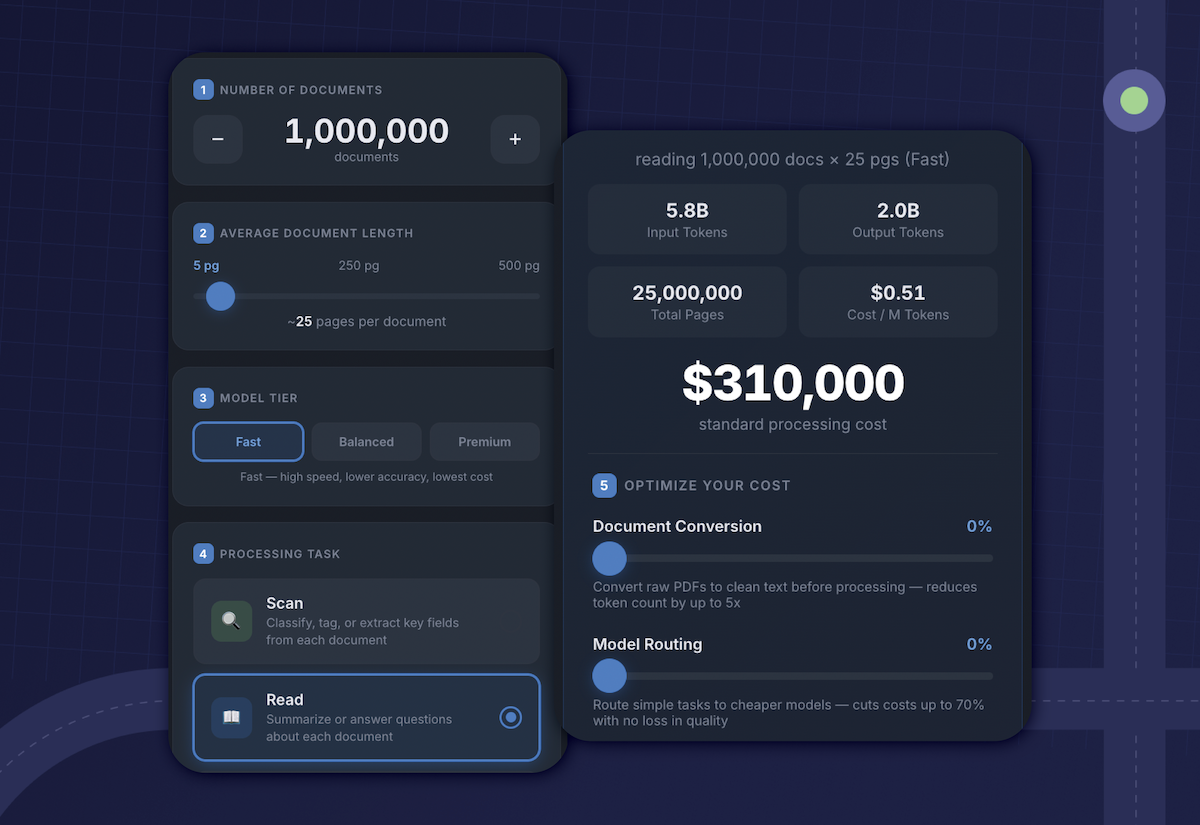
Finally, tokens. Tokens are the unit of cost in AI systems—roughly parts of words. If you’re working at scale, you need to understand tokens because they determine cost.
Token costs have dropped dramatically—from about $20 per million tokens in 2022 to around $0.02 today. At the same time, usage has exploded, driving massive revenue growth for AI companies.
Organizations are starting to track token usage, just like they track other resources. Managing this effectively requires engineering thinking: optimizing cost, routing workloads, and making trade-offs between quality and expense.
All of this brings us back again: AI is bad, AI is good, and AI is misunderstood.
To wrap up, think of this as a 3×3 framework: good, bad, misunderstood, combined with trust, throughput, and tokens.
Governance matters more than technology. Think probabilistically, not deterministically. Recognize the scale of data you’re dealing with. And understand that costs can be managed with the right approach.
AI presents risks and opportunities. The question isn’t just whether AI is good or bad—but what it could become.
Thank you very much.
Emphasize your product's unique features or benefits to differentiate it from competitors
In nec dictum adipiscing pharetra enim etiam scelerisque dolor purus ipsum egestas cursus vulputate arcu egestas ut eu sed mollis consectetur mattis pharetra curabitur et maecenas in mattis fames consectetur ipsum quis risus mauris aliquam ornare nisl purus at ipsum nulla accumsan consectetur vestibulum suspendisse aliquam condimentum scelerisque lacinia pellentesque vestibulum condimentum turpis ligula pharetra dictum sapien facilisis sapien at sagittis et cursus congue.
- Pharetra curabitur et maecenas in mattis fames consectetur ipsum quis risus.
- Justo urna nisi auctor consequat consectetur dolor lectus blandit.
- Eget egestas volutpat lacinia vestibulum vitae mattis hendrerit.
- Ornare elit odio tellus orci bibendum dictum id sem congue enim amet diam.
Incorporate statistics or specific numbers to highlight the effectiveness or popularity of your offering
Convallis pellentesque ullamcorper sapien sed tristique fermentum proin amet quam tincidunt feugiat vitae neque quisque odio ut pellentesque ac mauris eget lectus. Pretium arcu turpis lacus sapien sit at eu sapien duis magna nunc nibh nam non ut nibh ultrices ultrices elementum egestas enim nisl sed cursus pellentesque sit dignissim enim euismod sit et convallis sed pelis viverra quam at nisl sit pharetra enim nisl nec vestibulum posuere in volutpat sed blandit neque risus.
Use time-sensitive language to encourage immediate action, such as "Limited Time Offer
Feugiat vitae neque quisque odio ut pellentesque ac mauris eget lectus. Pretium arcu turpis lacus sapien sit at eu sapien duis magna nunc nibh nam non ut nibh ultrices ultrices elementum egestas enim nisl sed cursus pellentesque sit dignissim enim euismod sit et convallis sed pelis viverra quam at nisl sit pharetra enim nisl nec vestibulum posuere in volutpat sed blandit neque risus.
- Pharetra curabitur et maecenas in mattis fames consectetur ipsum quis risus.
- Justo urna nisi auctor consequat consectetur dolor lectus blandit.
- Eget egestas volutpat lacinia vestibulum vitae mattis hendrerit.
- Ornare elit odio tellus orci bibendum dictum id sem congue enim amet diam.
Address customer pain points directly by showing how your product solves their problems
Feugiat vitae neque quisque odio ut pellentesque ac mauris eget lectus. Pretium arcu turpis lacus sapien sit at eu sapien duis magna nunc nibh nam non ut nibh ultrices ultrices elementum egestas enim nisl sed cursus pellentesque sit dignissim enim euismod sit et convallis sed pelis viverra quam at nisl sit pharetra enim nisl nec vestibulum posuere in volutpat sed blandit neque risus.
Vel etiam vel amet aenean eget in habitasse nunc duis tellus sem turpis risus aliquam ac volutpat tellus eu faucibus ullamcorper.
Tailor titles to your ideal customer segment using phrases like "Designed for Busy Professionals
Sed pretium id nibh id sit felis vitae volutpat volutpat adipiscing at sodales neque lectus mi phasellus commodo at elit suspendisse ornare faucibus lectus purus viverra in nec aliquet commodo et sed sed nisi tempor mi pellentesque arcu viverra pretium duis enim vulputate dignissim etiam ultrices vitae neque urna proin nibh diam turpis augue lacus.